Managing a modern network manually is like watering a large garden with a bucket. When the garden is small, this works. As it grows, watering each plant individually becomes slow, inconsistent, and error-prone. Some areas receive too much water, others too little, and keeping everything healthy requires constant attention.
An irrigation system changes the operating model. Humans design the layout, define schedules, and set rules. The system then delivers water consistently, adapts to scale, and ensures the entire garden is maintained as intended. Network automation works the same way.
Engineers define the network design, rules, and constraints, while software executes changes consistently across the environment, validates outcomes, and continuously checks that the network remains compliant.
Why Network Automation?
Modern networks are complex, highly interconnected systems that span Data Centres, campuses, branch sites, cloud platforms, and third-party services, and they keep evolving.
As networks continue to grow in scale and complexity, manual operations become a source of risk. Small configuration inconsistencies compound over time, changes become harder to validate, and maintaining compliance shifts from an occasional exercise to a continuous operational requirement.
Network automation addresses these challenges by changing how networks are built, operated, and maintained. Instead of relying on manual intervention and individual expertise, it introduces a systematic, software-driven operating model that enables networks to be managed safely, consistently, and at scale.
Rather than engineers manually configuring each device, network automation separates decision-making from execution. Engineers focus on defining how the network should behave, while software carries out the work, validates results, and continuously checks for compliance.
Humans define:
Network architecture and design
Intent and desired outcomes
Standards, principles, and constraints
Policies and operational processes
Software handles:
Execution across devices and environments
Consistent application of changes
Validation before and after change
Repetition at scale
Ongoing compliance and drift detection
This approach goes beyond simple task automation. While automating individual tasks can be a starting point, true network automation changes how networks evolve over time.
Network automation applies software engineering concepts to networking, including version control, validation, repeatability, and testing, bringing greater rigor, predictability, and control to network operations.
What is it not?
Network automation is often misunderstood, especially by teams that have seen partial or unsuccessful attempts.
It is not simply a collection of scripts used to push configuration changes. While scripts can be useful, automation becomes fragile when it depends on individual logic, undocumented assumptions, or manual execution. Most importantly, network automation does not remove engineers from the process. Instead, it shifts their focus from repetitive execution to design, validation, and improvement.
True network automation introduces structure, repeatability, and visibility into network operations, reducing reliance on tribal knowledge and manual intervention.
Core principles
Network automation is built on a set of engineering principles that allow networks to scale safely and predictably.
Design and intent first
Engineers define how the network should behave. This includes desired outcomes, constraints, standards, and in some cases, engineered processes. Automation enforces these decisions consistently.
Systemised execution
Automation operates as a system, not a collection of one-off actions. Inputs are validated, logic is applied, outcomes are checked, and results are predictable.
Consistency at scale
Changes are applied uniformly across devices, sites, and environments, reducing configuration drift and unintended differences.
Repeatability and versioning
Network changes are predictable, traceable, and reversible. The same inputs always produce the same results, and historical states can be reviewed when needed.
Validation before and after change
Automation includes verification. Changes are checked before deployment and validated after execution to ensure the network behaves as intended.
Continuous compliance
Automation continuously checks the network against defined standards and policies, helping organisations maintain compliance over time rather than through periodic manual audits.
Where Network Automation Is Applied
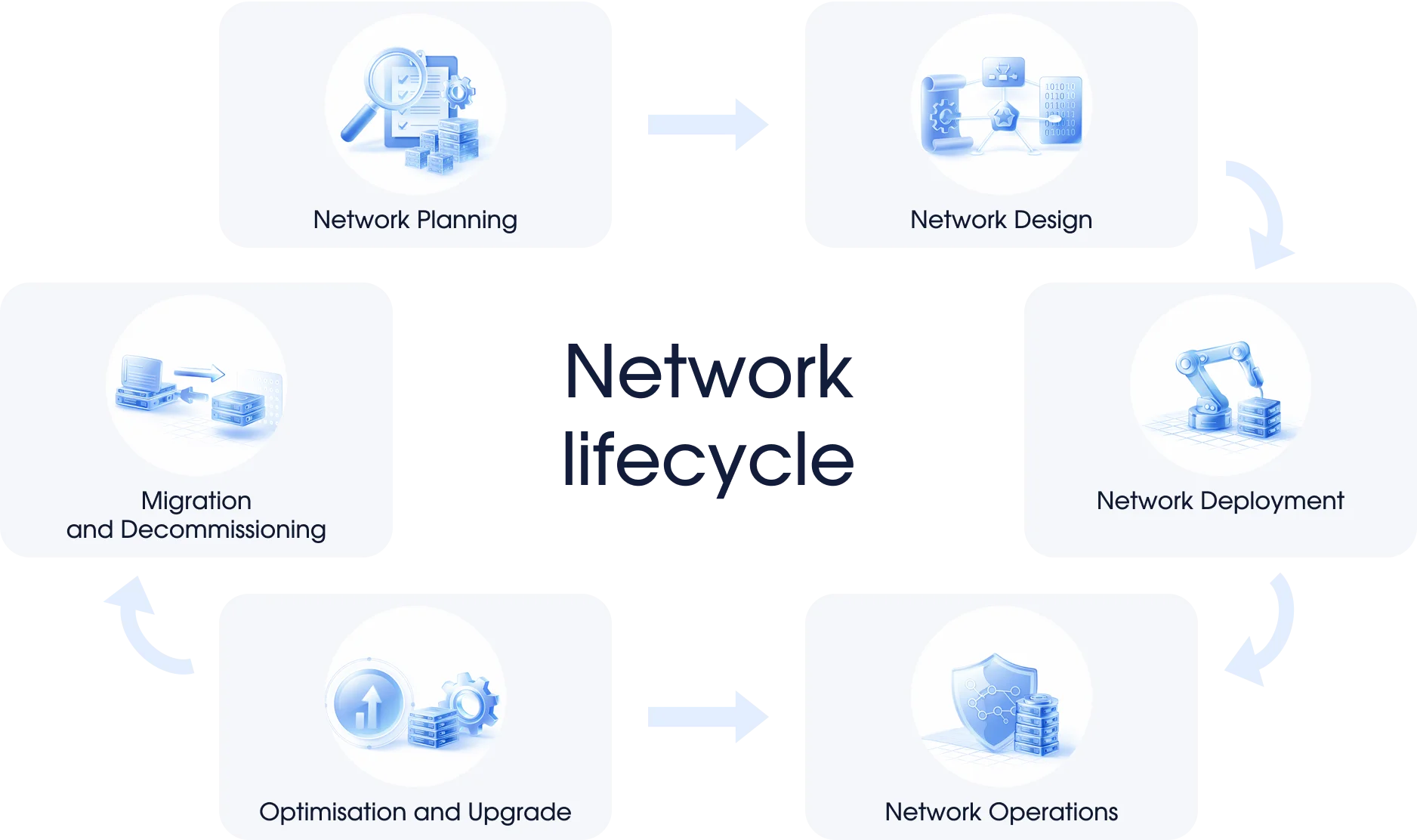
Network automation is not limited to a single phase of the network lifecycle. It can be applied from early planning through to migration and decommissioning. Its value compounds when used consistently across stages, rather than in isolation.
1
Network Planning:
Automation supports planning by analysing existing environments, validating assumptions, and producing consistent inputs for design. Inventory collection, state discovery, and baseline validation reduce guesswork and improve decision-making early in the lifecycle.
2
Network Design:
Design intent is captured in structured, reusable models rather than static documents. Addressing schemes, policies, topology patterns, and standards are defined once and reused consistently, forming a reliable foundation for downstream automation.
3
Network Deployment:
Automation enables predictable and repeatable deployments. New sites, devices, and environments are provisioned using predefined design patterns, often leveraging zero-touch provisioning, reducing deployment time, effort, and configuration risk.
4
Network Operations:
During day-to-day operations, automation enforces consistency and detects drift. Changes are executed in a controlled manner, configurations are continuously validated against intent, and operational processes become more transparent and auditable.
5
Optimisation and Upgrade:
Automation allows large-scale upgrades and design changes to be executed safely. Hardware refreshes, software upgrades, and architecture improvements are applied systematically, with validation before and after change to minimise disruption.
6
Migration and Decommissioning:
Complex migrations between platforms, vendors, or designs are managed with far less risk. Automation helps translate intent across different configuration models and ensures that legacy components are cleanly and safely decommissioned.
Shaping the Future of Networking
Network automation is reshaping how organisations build and operate their networks. As environments grow in scale, complexity, and business criticality, manual operations no longer provide the speed, consistency, or confidence modern organisations require.
Automation introduces a fundamentally different way of thinking about networks. For engineers, it elevates the role from device operators to system designers. For organisations, it creates confidence that the network can keep pace with growth, transformation, and uncertainty, without becoming a constraint. Networks evolve from fragile systems into adaptable platforms that can respond to change with intent.
Nexivity helps organisations make this transition in a practical, considered way. We turn automation from isolated tooling and one-off scripts into a lasting capability, embedded in how networks are designed, changed, and operated. Our work is grounded in engineering principles, intent-driven design, and the realities of running production networks.
By making design intent explicit, systemising change execution, and validating outcomes continuously, Nexivity enables networks to evolve safely alongside the business. Change becomes predictable, compliance becomes measurable, and scale no longer depends on manual effort or individual expertise.
If you are ready to explore what that future could look like for your network, let’s have a conversation.
Ready to Automate Your Network?
Speak with a Network Automation Engineer today and get expert guidance for your automation journey